How to Participate

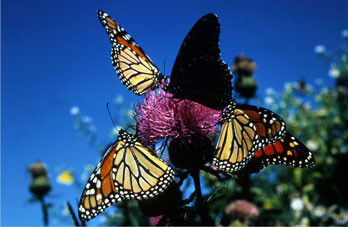
Take your class on a journey throughout the 2008-09 school year and travel with us during the migration of the monarch butterfly (Danaus plexippus).  This migration is one of the most spectacular events in the insect work, and every year, millions of delicate but hardy monarchs and their offspring travel  thousands of miles from Canada and the United States to overwinter in just a few mountain peaks in the states of Mexico and Michoacán, Mexico. 

This magical journey has also been deemed an “endangered natural phenomenon.” Monarch butterflies are dependent on conservation of habitats in all three North American countries – United States, Canada,  and Mexico. In February 2008, take your class on a live, interactive electronic field trip to Mexico where we will join scientists studying monarchs and local people who are preserving winter habitat.

You may participate in this adventure in a number of ways:

The following hardware and software are required to view the webcasts. 

Component

Required

Recommended

Operating system

Microsoft Windows® XP Home Edition,
Windows XP Professional, or
Windows XP Media Center Edition

Windows XP Home Edition,
Windows XP Professional, or
Windows XP Media Center Edition
and
Windows XP Service Pack 2
and
Windows Media Player 10 works best with the latest software version of the Player and operating system.

Processor

A 233 megahertz (MHz) processor, such as an Intel Pentium II or Advanced Micro Devices (AMD) processor

A 1.5 gigahertz (GHz) processor or faster.

RAM

64 megabytes (MB)

512 MB or higher

Internet Connection

Active broadband connection at a minimum bandwidth of 282 Kbps.

Active broadband connection with bandwidth of greater then 768 Kbps.

Sound card

16-bit sound card

24-bit sound card

Monitor

Super VGA (800 x 600) resolution

Same as required configuration or higher resolution

Video card

Video card with 64 MB of RAM (video RAM or VRAM) and DirectX generation

Video card with 256 MB of RAM or higher and DirectX 9.0b or later generation.
For more information about DirectX, see the Microsoft DirectX Web site.

Sound output device

Speakers or headphones

Speakers or headphones

Internet browser

Microsoft Internet Explorer 6 or Netscape 7.1

Microsoft Internet Explorer 7


For MAC OS users

In order to view the video stream, you may need to install "WMV Components" for your Quicktime player. Go to flip4mac.com to install WMV Components by Flip4Mac.http://www.flip4mac.com/support_wmv.htm

Instructions:

Click on the "WMV Components 2.2" download link and install the tool.
Click on the "Launch test video" link above and check to see if video streaming now works. If it does not work, you may need an additional utility. Download and install the "Flip4Mac Streaming Utility" on that same download page.
Launch the "Flip4Mac Streaming Utility" and check the checkbox that comes up.
Now video streaming should work. Click the "Launch test video" link again.

Flip4Mac is a recommendation for Mac viewers to view the .wmv web cast.  

The schedule for the webcasts, broadcasts, and webchat is as follows:

MonarchLIVE Kick-off
Friday, October 10, 2008
Noon – 1 p.m. Eastern Time English
Webcast and satellite broadcast
(Spanish will be streamed live on the Internet.)
Join us in Virginia as we kick off Monarch Live.  We will be reviewing monarch biology, citizen science programs, and the importance of stewardship.
The satellite coordinates are as follows:
C-Band Analog
AMC3 C-22
87 Degrees
Dnlink Freq 4140 V

In the Mexican Mountains
Tuesday, February 17, 2009
Noon – 1 p.m. Eastern Time English only
SES American AMC-3 C-Band Analog
87 Degrees West
Transponder / Channel 22 Vertical
Downlink Frequency 4140
Audio 6.2 / 6.8
2 – 3 p.m. Eastern Time Spanish only
Webcast and satellite broadcast
Join in the first ever live webcast and satellite broadcast from the Monarch Butterfly Biosphere Reserve.  Biologists will discuss the monarchs’ overwintering habitat and biology. 

Community Conservation in Mexico
Thursday, February 19, 2009
Noon – 1 p.m. Eastern Time English only
2 – 3 p.m. Eastern Time Spanish only
Webcast and satellite broadcast
Visit with local people living in the monarch butterfly region who are involved in conservation and developing sustainable livelihoods.  The program will be broadcast and webcast from Alternare, a non-profit organization that works in close partnership with campesinos in the monarch wintering areas to promote sustainable and adequate food production, forest conservation, and environmentally sound economic activities.

Little Spaces; Big Results
Tuesday, May 19, 2009
Noon – 1 p.m. Eastern Time English
Webcast and/or satellite broadcast
(Spanish will be streamed live on the Internet.)
Butterfly gardens can be created everywhere!  Join us in Chicago to learn how small garden plots can have big results for both butterflies and people. 

Building the Population
Thursday, May 21, 2009
Noon – 1 p.m. Eastern Time English
Webcast and/or broadcast
(Spanish will be streamed live on the Internet.)
Visit Minnesota to learn about monarchs’ summer behavior and population growth, citizen roles in monitoring the population, and threats to monarchs. 

Monarchs in Canada
Monarchs depend on healthy habitats in three countries, and Canada provides a welcome summer home to thousands. CLICK HERE for a PowerPoint presentation about Monarchs in Canada and Point Pelee National Park.


To view a telecast about MonarchLIVE , go to http://www.ntc.blm.gov/krc/uploads/250/Monarch.html. This program was produced for federal agency environmental education and interpretation staff to learn how they can be involved in "Let's Go Outside" efforts, such as planting pollinator gardens with local schools or youth groups, as part of the MonarchLIVE programs. The program was produced by the Partners in Resource Education (BLM, EPA, FS, FWS, NOAA,
NPS, and NRCS)and broadcast by the U.S. Fish and Wildlife Service. Presenters include: Sandy Frost, U.S. Forest Service; Kristy Liercke, Prince William Network; Kathy McGlauflin, Project Learning Tree; Donita Cotter, U.S. Fish and Wildlife Service; and Randy Robinson, U.S. Fish and Wildlife Service.